
Low Power Design Techniques in VLSI: Essential Concepts for Energy-Efficient Chip Design


In today’s semiconductor scenario, optimizing power consumption is no longer just an option but is essential. However, with the rise of smartphones, IoT devices, wearables, and high-performance computing systems, engineers need to balance performance and energy efficiency. This is where low-power design techniques become crucial in modern chip development.
In today’s blog, we are going to explore the fundamentals of low-power chip design, key methods, challenges, and all the concepts that are used in low-power design techniques and VLSI design.
Understanding Power Consumption in Chip Design
Before understanding all the techniques in detail, it is important to understand where power is consumed in a chip. Broadly, power dissipation is divided into:
Dynamic Power: Caused by switching the activity in circuits (charging and discharging capacitances)
Static Power: Occurs even when the circuit is idle due to leakage currents
The dynamic power is often expressed as proportional to switching activity, capacitance, voltage, and frequency, which makes this a low-voltage circuit design, a key strategy for reducing power consumption. As chip complexity increases and transistor sizes shrink, managing both dynamic and static power becomes increasingly challenging.
Why Low Power Design Matters?
Be it mobile devices or data centers, power efficiency directly impacts user experience and system performance. As a result, low-power chip design has truly become a core requirement in semiconductor engineering.
Modern electronic systems demand:
- Longer battery life
- Reduced heat generation
- Improved reliability
- Lower operational costs
Essential Low Power Design Techniques
1. Clock Gating
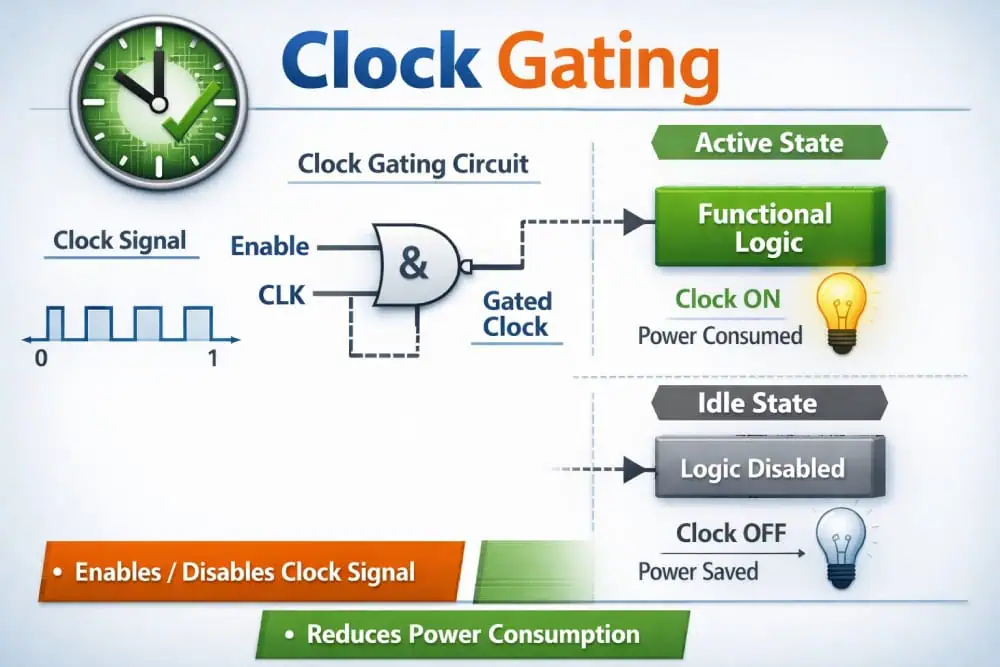
Clock gating is one of the most commonly used low-power design techniques, as it works by just turning off the clock signal to portions of the circuit that are not actively switching.
- Reduces unnecessary toggling
- Saves dynamic power
- Improves overall efficiency
2. Power Gating
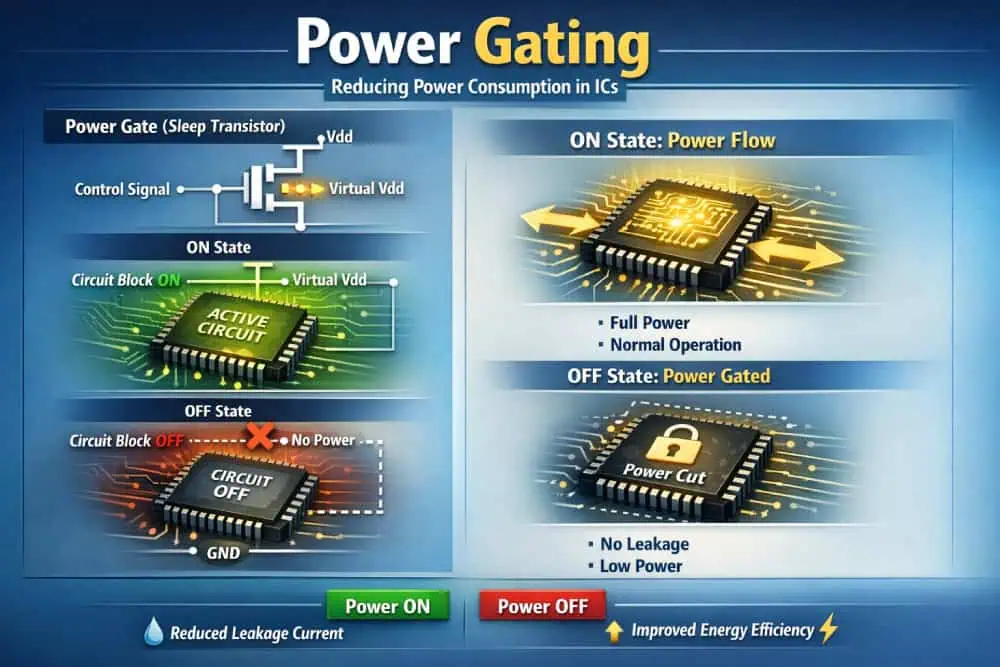
Power gating is another technique that is used to reduce leakage (static) power by completely shutting off power to inactive blocks.
- Turns off unused sections of the chip
- Saves both static and some dynamic power
- Requires additional design considerations, like isolation cells
However, powering blocks back on may require reinitialization, adding design complexity.
3. Dynamic Voltage and Frequency Scaling (DVFS)
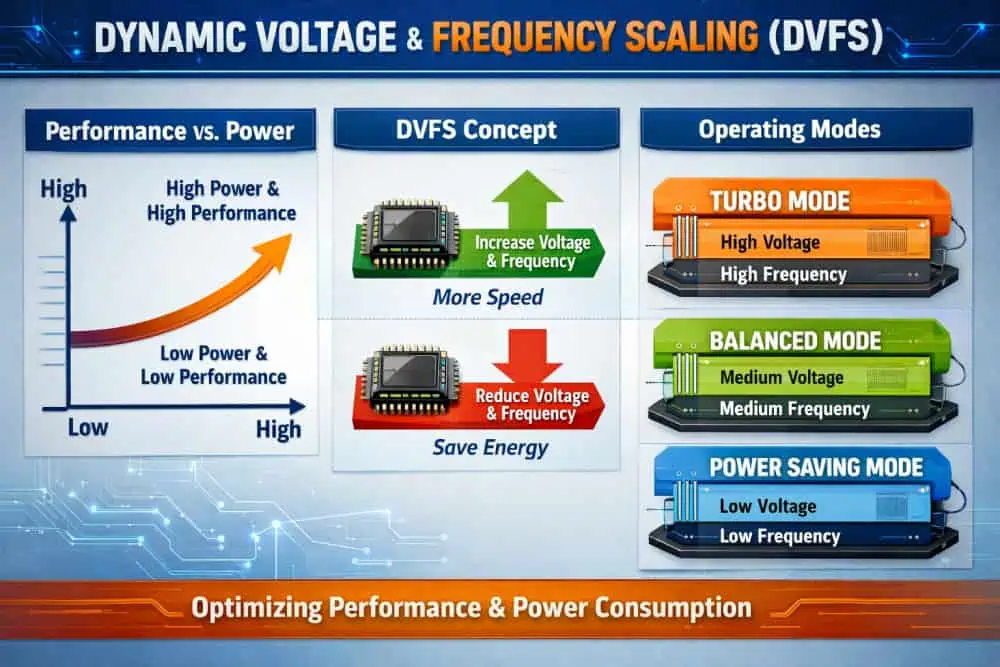
DVFS is a powerful method in low voltage circuit design where the voltage as well as the frequency are really adjusted well according to their workload.
High performance → higher voltage and frequency
Low activity → reduced voltage and frequency
Here, since the power is proportional to the square of voltage, reducing the voltage significantly lowers the power consumption.
4. Multi-Voltage Domains (Voltage Islands)
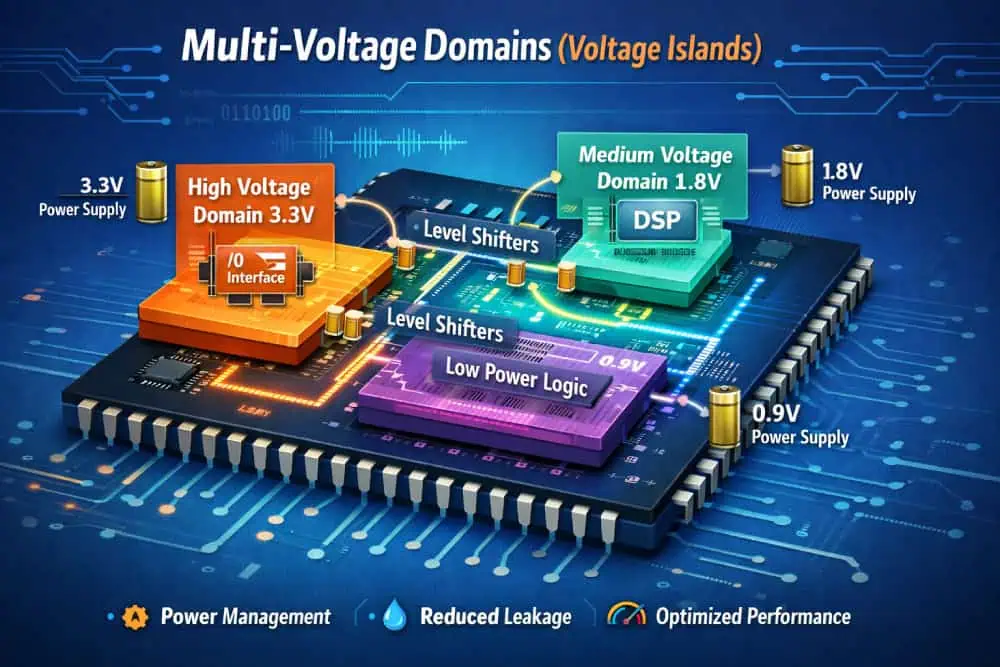
Modern chips are also often seen using voltage domains:
- High voltage for performance-critical blocks
- Low voltage for less critical sections
With this kind of approach, it optimizes the power without compromising performance and is widely used in low-power design techniques and VLSI design.
5. Retention Techniques
Retention techniques are the ones that allow circuits to preserve their state even when powered down.
- In this system, the special flip-flops are used with backup power
- Modifications to faster wake-up times
- Adds area and design complexity
This is particularly useful in systems that frequently switch between active and sleep modes.
6. Save and Restore Methods
Instead of retaining the state in hardware, this technique is what helps to store the data externally before powering down and restores it during wake-up.
- Useful for long power-off durations
- Adds latency and area overhead
- Common in advanced low-power chip design structures
Role of Low Voltage Circuit Design
Voltage scaling is one of the most effective ways to reduce power consumption. Since dynamic power depends on voltage squared, even a small reduction in voltage can give a lot of savings.
However, reducing voltage also comes with different types of challenges, which are:
- Reduced noise margins
- Slow circuit performance
- Increased sensitivity to changes
Designers need to carefully balance the voltage levels to make sure there is functionality, all while achieving energy efficiency.
Challenges in Low Power VLSI Design
While low-power design techniques do provide significant benefits, they also introduce different complexities:
- Better design and verification effort
- Complex power domain management
- Need for specialized tools and techniques
- Trade-offs between power, performance, and area
What Are the Best Practices for Effective Low Power Design?
To successfully add the low-power design techniques to the VLSI design, engineers must:
- Optimize at multiple levels (architecture, RTL, circuit, physical design)
- Use power-aware design methods
- Implement efficient clock and power gating tricks
- Leverage advanced tools for power analysis and optimization
- Carefully design power grids and domains
Therefore, a proper holistic approach makes sure there is maximum efficiency without compromising performance.
Conclusion
The growing, consistent demand for energy-efficient electronics has made low-power design techniques a cornerstone of modern chip design. From clock gating and power gating to DVFS and voltage islands, these are the techniques that allow designers to build high-performance yet energy-efficient systems.
As semiconductor technologies continue to evolve, mastering low-power chip design and low-voltage circuit design is going to be very crucial for engineers who are working in advanced VLSI systems. By integrating all the explained techniques early in the design cycles, companies can truly achieve optimal performance, decreased power consumption, and improved product reliability.
Are You Looking to implement advanced low-power design techniques in your next project? Explore our expert solutions in Electrical Hardware Design Services to build scalable and high-performance chip designs as per your needs.