

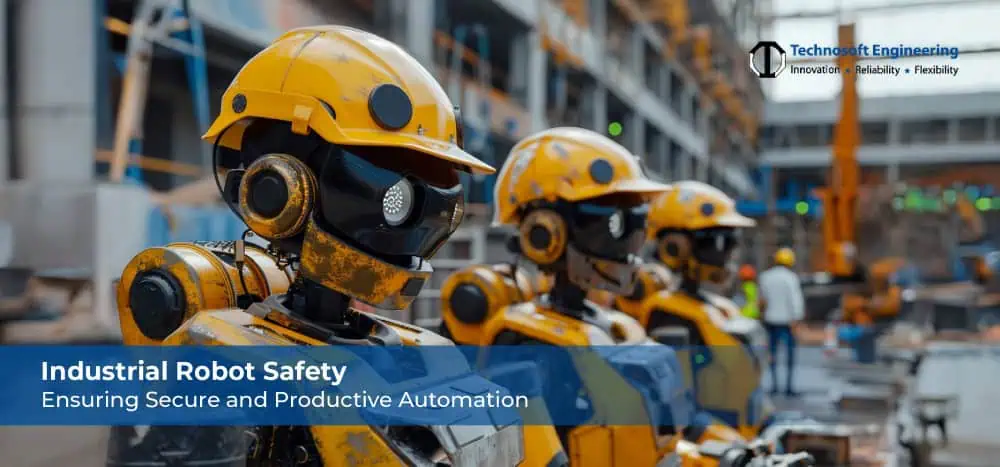
If we see today’s manufacturing sector, automation powered by robotics is transforming how industries are operating on large scales. Right from assembly lines to warehousing, robots boost productivity, consistency, and precision. But as their presence grows, so does the need to prioritize safety. Industrial robots are powerful machines with potential to cause severe injury or maybe damage if they are not controlled in a proper. In this entire comprehensive guide, we explore industrial robot safety, the risks that are involved, the strategies to reduce hazards, and how modern safety standards help companies to create safe working environments.
The Importance of Industrial Robot Safety
The main importance is industrial robot safety that focuses on protecting human workers, protecting tools, and maintaining process efficiency. Robots can easily perform repetitive tasks with speed and accuracy far better than human abilities, but there are unexpected movements, collisions, electrical faults, and system failures are at real risks when there is lack of safety measures. As automation keeps growing in industries, manufacturers need to understand and implement safe practices to foster environments where humans and robots can coexist in a better and productive way.
Top Hazards in Robot-Assisted Workplaces
Industrial robots pose several types of hazards that needs to be controlled:
- Unexpected robot movements: Programming errors, malfunctions, or control problems can cause a robot losing control, potentially colliding with workers or equipment.
- System failures: Like any machinery, robots can also suffer through breakdowns, leading to sudden jerks or shutdowns.
- Collision risks: When humans and robots share a workspace or during maintenance sessions, collisions become a serious concern.
- Electrical hazards: Robots are powered by high-voltage systems that can present shock risks during operation or service.
What Are Robot Safety Standards?
Robot safety standards do play a crucial role in ensuring safe implementation of operation of the entire robotic systems. These standards offer guidelines for design, installation, integration, and use of robots to reduce hazards.
The Key standards are ISO 10218, which sets international guidelines for robot safety requirements, and ISO/TS 15066 for collaborative robot applications.
Beyond ISO organizations, such as ANSI and the Robotic Industries Association develop regional safety documents that expand on risk assessment methods as well as safe system design. Even though specific OSHA standards for robotics do not exists yet, general industry regulations are there enforcing machine guarding, lockout/tagout procedures, and hazard controls that are relevant to robotic systems. Therefore, to these well-recognized frameworks helps companies not to just protect personnel but also improves reliability as well as productivity during operations.
Important Industrial Robot Safety Rules
To implement the safety principles, industries are known to adopt industrial robot safety rules that administer daily interaction with robotics. These rules often include:
Physical safeguards: These includes, fences, light curtains, safety mats, and barriers prevent unauthorized access for robot workspaces.
Emergency stop controls: There are clearly labeled and accessible E-stop buttons allow machines to be halted immediately when there is case of emergency.
Training programs: Workers need to be trained to recognize hazards, understand safety procedures, and properly interact with robots.
Risk assessments: Routine evaluations are great to identify potential weak points in robot workflows and prioritize corrective action.
Risk Mitigation Strategies
Industrial robot safety does not stop only at compliance; it extends into daily operational practices. A strong safety strategy combines identification; it extends into daily operational practices. A strong safety strategy includes identification, evaluation, control, and continues monitoring. This means evaluating the robot’s work area, identifying all risk factors, and then determining the best control measures, whether that’s by adding physical barriers, updating programming limits, or enhancing sensors.
Therefore, integrating preventive measures, such as machine vision systems, motion detectors, and redundancy in control systems further enhances protection. Modern sensors are best to detect when human staff enters the critical zones and slow down or stop robotic movement to avoid accidents.
Collaborative Automation & Safety
The rise of collaborative robotics, where humans and machines work closely and demands advanced safety designs and protocols. Collaborative robots often include built-in force limiters and sensors that helps to reduce speed or stop movement if contact occurs. These features enable robots to support human workers without the extensive guarding required in fully automated cells.
Safety Is Part of Robot System Design
Adding safety early in the design phase makes sure robotics installations are very much secure. Right from sensor selection to control architectures, designing with safety in mind prevents many common hazards associated with robot operations. When companies intentionally invest in Robust Robot Design, they lay a strong foundation for safe performance that protects staff as well as machines.
In the same way, understanding specific automation solutions, such as Robotic Palletizing Systems and their operational meaning allows engineers to modify their safety measures that align with use-case needs.
Using the Right Industrial Robots types
Different robotics uses needs different safety approaches. Heavy payload arms, mobile platforms, conveyer integrations and collaborative robots each pose unique challenges. By categorizing systems as per their functions and environments, such as fixed industrial cells VS mobile automated guided robots; businesses can apply specific safety solutions that fit every scene. Using data from Industrial Robots types into safety planning helps to improve risk analysis and supports compliance with applicable standards.
Building a Safety-First Culture
Finally, industrial robot safety is more than technical rules, it is a mindset. So, focusing more on open communication about hazards, regular training, refreshers, and employee involvement in safety discussions builds a culture where workers feel free to report any mishaps. When safety becomes part of the company’s core values, automation goes hand in hand without compromising the quality.
Ready to Elevate Your Automation Safety?
At Technosoft, we are here to help all manufacturers to implement compliant, robust robotics systems that is prioritize safety without hampering efficiency.