

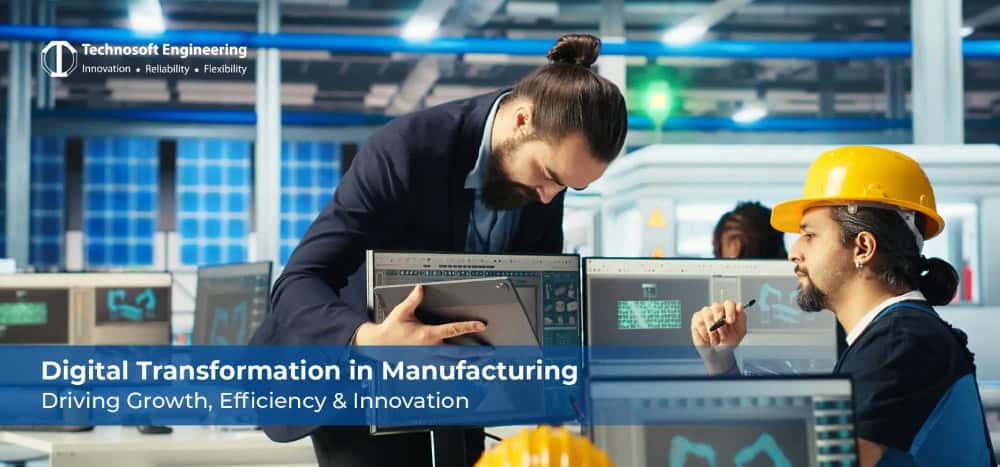
When we see the current industrial landscape, digital transformation in manufacturing is no longer a futuristic ambition, but it is a strategic imperative. Manufacturers are currently under huge pressure to reduce costs, improve quality, enhance time-to-market, and increase flexibility. By adapting to the manufacturing digital transformation, companies can find new ways of operating, creating value, and staying ahead of the competition.
While many firms may consider digital upgrades as optional, the reality is that industrial digital transformation is the root solution to survive in a disrupted marketplace. The application of digital technology in manufacturing touches everything from asset optimization to productivity to fast industrialization.
Why Is Manufacturing Digital Transformation Essential?
To know the importance of manufacturing digital transformation, you must consider three major dimensions: competition, scale, and execution. First, global research says that by 2027, global digital transformation (DX) spending for discrete manufacturing is expected to increase. Next, several manufacturers are running DX initiatives at multiple numbers at once, and without a clear strategy, those efforts risk being scattered and useless. Third, a transformation that is not measured or tied to business value frequently fails to deliver the expected benefits. So basically, for manufacturers, digital transformation in manufacturing means more than digitalizing processes, which provides improved efficiency.
Key Benefits of Digital Transformation in Manufacturing
The benefits of digital transformation in manufacturing are significant, and when properly implemented, they deliver great results.
1. Cost reduction and improved efficiency
By applying digital technologies, manufacturers can streamline all their workflows, reduce waste, eliminate manual inefficiencies, and reduce the overall cost.
2. Quality and time-to-market improvement
Digital transformation helps manufacturers to use data-driven information, closed-loop processes, and feedback in real time.
3. Greater flexibility and agility
With the help of digital technology in manufacturing, companies can respond faster to market changes, customize the products, and upscale operations in an easy way. The increased visibility and data-driven decisions allow more flexible operations.
4. Business model transformation and growth
Beyond operations, digital transformation in industries opens avenues for new services, continuous revenue, remote diagnostics, and smarter asset-centric business models. When manufacturers mostly adopt digital at the strategic level, they are known to shift from simply producing to enabling.
So, the benefits of digital transformation in manufacturing are compelling.
In short, the benefits of digital transformation in manufacturing are strong, and the payoff grows when technology investments sync with the business goals and outcomes.
Digital Technology in Manufacturing: What Enables Transformation
What does it take to make a successful manufacturing digital transformation? It begins with harnessing the right digital technology in manufacturing and embedding it across processes, assets, and people.
Important enablers are as follows:
Sensors, connectivity, and data analytics: These tools provide real-time visibility in equipment performance, production flows, and quality metrics.
Internet of Things (IoT): This is central to capturing machine and operational data that offers new data and allows predictive maintenance.
Cloud computing: Functioning as a flexible, scalable infrastructure support, cloud computing allows connected systems, data storage, analytics, and collaboration.
Digital thread and digital twin: Enabling a seamless data flow through design, manufacturing, service, and end-of-life, helping reduce silos and pushing towards improvements.
Workforce empowerment technologies: AR instructions, mobile connectivity, and collaboration platforms all help improve productivity and knowledge sharing. When these technologies come together under an aligned strategy, industrial digital transformation becomes workable and impactful.
Why IoT Is Important for Digital Transformation?
A spotlight on one powerful tool, which is the Internet of Things (IoT), and understanding why IoT is important for digital transformation. This helps to clarify how manufacturing firms capture value:
- Real-time asset monitoring: IoT devices work to transmit data from machines, enabling manufacturers to move from reactive to active maintenance. This helps to improve the uptime and reduce sudden breakdowns.
- Data-driven decision-making: IoT produces rich data streams. When analyzed, they drive important information in process optimizations, energy use, throughput, and quality improvements.
- Connected operations: With systems that include IoT, factories are known to gain visibility into production workflows, supply chain links, and field service integration, dissolving traditional silos.
- New services and business models: IoT makes it possible to deliver remote monitoring, with uptime guaranteed, and outcome-based services. All part of the industrial digital transformation journey.
Cloud Computing Role in Digital Transformation
The main focus here is on manufacturing; it is worth noting the Cloud computing in digital transformation. Cloud platforms provide scalable data storage, analytics engines, connectivity across different virtual infrastructures, and tools. In a manufacturing setting, cloud helps to provide centralized access to production, quality, and service data across different locations, boosting agility and allowing industrial digital transformation at scale.
Conclusion
In today’s industrial world, adapting to digital transformation in manufacturing has become a necessity because it has become a part of a core strategy. Whether you are willing to upgrade your assets, modernize production lines, or are ready to launch a new service, the goal stays the same: using technology in manufacturing increases efficiency. By adapting to an integrated approach that combines IoT, cloud computing, analytics, and workforce tools, manufacturers can achieve true industrial digital transformation. At Technosoft Engineering, we are here to help you start this journey and translate technology into measurable business value.
Are You Ready to begin your manufacturing digital transformation journey? Connect with our team today to explore how our Cloud & Digital Transformation Services can help you design, implement, and scale your digital first step.