

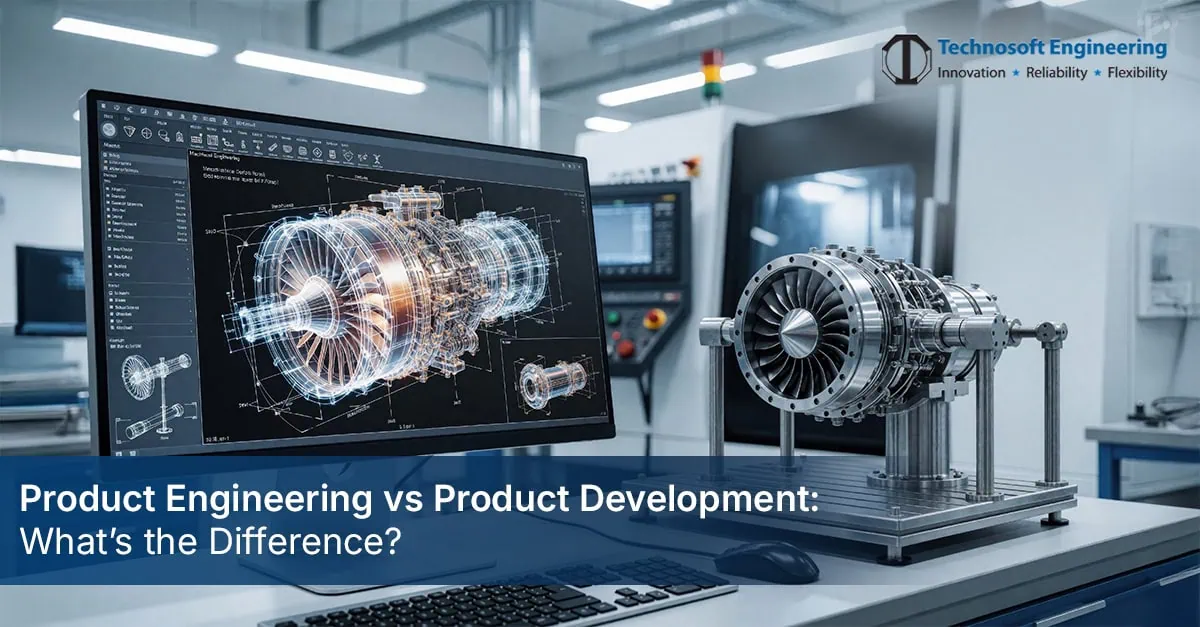
Product Engineering and Product Development are two closely connected processes that help businesses create innovative and market-ready products. Although these terms are often used interchangeably, they have different objectives and responsibilities.
Product Development focuses on the complete journey of transforming an idea into a market-ready product, while Product Engineering emphasizes the technical design, development, testing, and optimization required to make that product functional and reliable.
Understanding Product Engineering vs Product Development helps manufacturers and engineering businesses improve product quality, reduce development costs, and accelerate time to market.
Let’s explore their key differences, processes, benefits, and how they work together.
What Is Product Engineering?
Product Engineering is the process of applying engineering principles, technologies, and technical expertise to design, develop, test, and optimize products.
It focuses on ensuring that products meet functional requirements, deliver reliable performance, and can be manufactured efficiently.
For example, developing an industrial automation machine involves mechanical design, electrical engineering, control system integration, simulation, and performance testing.
Key Activities in Product Engineering
- Product Design: Creating 2D drawings, 3D models, and engineering designs using CAD tools.
- Engineering Analysis: Evaluating product strength, performance, and reliability through CAE and simulation.
- Prototyping and Testing: Identifying design issues and validating product functionality.
- System Integration: Combining mechanical, electrical, and software components.
- Design Optimization: Improving product performance, reducing material costs, and enhancing manufacturability.
Benefits of Product Engineering
- Improves product quality and reliability.
- Reduces design errors and engineering costs.
- Enhances product performance.
- Improves manufacturing efficiency.
- Supports faster product development.
What Is Product Development?
Product Development is the broader process of transforming an idea or business requirement into a finished product that meets customer expectations and market demands.
It includes market research, idea generation, concept development, product design, engineering, testing, manufacturing preparation, and product launch.
For example, a manufacturer planning to introduce a new packaging machine must first understand customer requirements, evaluate market opportunities, define product features, and assess technical feasibility before moving into engineering and production.
Key Activities in Product Development
- Market Research: Identifying customer needs, industry trends, and market opportunities.
- Idea Generation: Exploring new product concepts and business opportunities.
- Concept Development: Defining product features, functionality, and specifications.
- Product Design: Creating initial designs, models, and prototypes.
- Testing and Validation: Evaluating product performance, safety, and reliability.
- Manufacturing and Launch: Preparing production processes and introducing the product to the market.
Benefits of Product Development
- Creates products aligned with customer requirements.
- Reduces development and market-related risks.
- Encourages innovation and competitiveness.
- Improves collaboration between business and engineering teams.
- Supports faster product launches.
Product Engineering vs Product Development: Key Differences
Although both processes contribute to successful product creation, their scope and objectives differ.
|
Comparison Factor |
Product Engineering |
Product Development |
|
Primary Focus |
Technical design and optimization |
Complete product creation |
|
Main Objective |
Ensure functionality and reliability |
Develop market-ready products |
|
Scope |
Engineering and technical activities |
Entire product lifecycle |
|
Starting Point |
Product requirements and specifications |
Market needs and product ideas |
|
Key Activities |
CAD, CAE, simulation, testing, and optimization |
Research, planning, design, development, and launch |
|
Teams Involved |
Mechanical, electrical, and software engineers |
Product managers, designers, engineers, and marketing teams |
|
Expected Outcome |
Functional and optimized product |
Commercially viable product |
In simple terms: Product Development determines what product should be created and why, while Product Engineering focuses on how to design, build, test, and optimize it.
How Product Engineering and Product Development Work Together
Product Engineering and Product Development are interconnected processes. Both are necessary to create products that meet technical requirements and business objectives.
Product Development establishes the product concept, market requirements, and overall strategy. Product Engineering translates those requirements into technical designs through engineering analysis, prototyping, and testing.
For example, when developing an automated packaging machine:
- Market Research: Identify customer requirements and automation opportunities.
- Concept Development: Define machine capabilities and technical specifications.
- Engineering Design: Develop mechanical designs, electrical systems, and control layouts.
- Prototyping and Testing: Validate machine performance and identify design improvements.
- Manufacturing Preparation: Optimize the design for production, assembly, and maintenance.
- Product Launch: Introduce the final solution to the market.
Combining both approaches helps businesses improve product quality, minimize development risks, and achieve better time-to-market performance.
Understanding the Product Development Lifecycle
The Product Development Lifecycle represents the different stages a product goes through, from initial idea generation to market launch and continuous improvement.
The main stages include:
1. Research and Ideation
Identify customer problems, market opportunities, and potential product ideas.
2. Concept Development
Once an idea is selected, teams define product specifications, technical requirements, functionality, performance expectations, and estimated development costs.
3. Design and Engineering
Create detailed product designs, CAD models, and engineering drawings while evaluating technical feasibility.
4. Prototyping and Testing
Develop prototypes and conduct testing to validate product performance, safety, and reliability.
5. Manufacturing and Production
After design validation, the product moves into manufacturing preparation and production. This stage involves material selection, production planning, process optimization & quality control.
6. Product Launch and Improvement
Introduce the product to the market and use customer feedback to identify future improvements.
A structured lifecycle helps businesses improve coordination, control development costs, and maintain product quality.
How Product Engineering Services and Product Development Services Help Businesses
As products become more complex, businesses often need specialized engineering expertise to manage technical challenges and improve development efficiency.
Product Engineering Services
Product Engineering Services provide technical support across product design, engineering, testing, and optimization.
Common services include:
- Mechanical design and 3D modeling.
- CAD drafting and engineering design.
- Electrical and electronics engineering.
- CAE analysis and simulation.
- Prototyping and product validation.
- Design optimization.
Product Development Services
Product Development Services support businesses throughout the broader product creation process, from concept development to production readiness.
Common services include:
- Product concept development.
- Product design and engineering.
- Prototype development and testing.
- Technical feasibility assessment.
- Design validation and optimization.
- Manufacturing engineering support.
Working with an experienced engineering partner helps businesses access specialized capabilities, manage complex projects, and improve product development efficiency.
Conclusion
Understanding Product Engineering vs Product Development helps businesses establish the right approach to creating successful products.
While Product Development focuses on transforming ideas into market-ready solutions, Product Engineering ensures those products meet technical, functional, and performance requirements.
Both approaches are essential for improving product quality, reducing development costs, and responding to changing market demands.
By combining engineering expertise, structured development processes, and advanced technologies, businesses can streamline the Product Development Lifecycle and build innovative products.
Technosoft Engineering supports businesses with specialized engineering capabilities to address complex product design, development, and manufacturing requirements.
Frequently Asked Questions (FAQs)
1. What is the main difference between Product Engineering and Product Development?
Product Engineering focuses on technical design, development, testing, and optimization, whereas Product Development covers the complete process from idea generation to product launch.
2. Is Product Engineering part of Product Development?
Yes. Product Engineering is generally a specialized part of the broader Product Development process, focusing on technical design and execution.
3. What are the main stages of the Product Development Lifecycle?
The main stages include research, ideation, concept development, design, engineering, prototyping, testing, manufacturing, and product launch.
4. What do Product Engineering Services include?
They typically include mechanical design, CAD modeling, electrical engineering, CAE simulation, prototyping, testing, and design optimization.
5. Why are Product Development Services important?
They help businesses transform ideas into market-ready products through structured research, design, engineering, testing, and manufacturing support.