

Manufacturing efficiency depends not only on advanced machinery and technology but also on how effectively a facility is planned and organized. Poor equipment positioning, unnecessary material movement, and inefficient space utilization can increase production costs and create operational bottlenecks.
Plant Layout Design plays an important role in developing an organized manufacturing environment. It involves strategically arranging machinery, workstations, storage areas, utilities, and material handling systems to support smooth production operations.
For manufacturers planning a new facility or upgrading an existing one, an effective layout helps improve productivity, reduce operational expenses, enhance workplace safety, and support future expansion.
What Is Plant Layout Design?
Plant Layout Design refers to the systematic arrangement of physical resources within a manufacturing facility to achieve efficient production operations. It includes the positioning of machines, equipment, departments, storage areas, transportation routes, and supporting infrastructure.
A well-planned Manufacturing Plant Layout ensures that materials, workers, and products move efficiently between different production stages.
The primary objective is to minimize unnecessary movement, optimize available space, improve workflow, and ensure that all manufacturing activities operate in coordination.
Objectives and Importance of Plant Layout
An effective plant layout supports several important manufacturing objectives:
- Better Space Utilization: Organizes machinery, equipment, and storage areas to make the best use of available floor space.
- Reduced Material Handling: Minimizes the distance travelled by raw materials, work-in-progress products, and finished goods.
- Smooth Production Flow: Ensures that manufacturing activities follow a logical sequence with fewer interruptions.
- Improved Resource Utilization: Helps optimize the use of manpower, machinery, and other production resources.
- Enhanced Workplace Safety: Provides adequate space, clear pathways, and convenient access to safety facilities.
- Future Flexibility: Allows manufacturers to accommodate new equipment, production processes, and changing business requirements.
These objectives make plant planning an important part of overall manufacturing facility development.
Key Principles of Effective Plant Layout Design
A successful manufacturing plant layout design should follow these essential principles:
1. Principle of Integration
All manufacturing resources, including machinery, materials, manpower, and supporting services, should work together efficiently. Proper integration improves coordination between departments and reduces operational interruptions.
2. Principle of Minimum Movement
The layout should minimize unnecessary movement of materials, workers, and equipment. Strategically positioning workstations and storage areas helps reduce material handling time, transportation costs, and production delays.
3. Principle of Optimum Space Utilization
Available floor and vertical space should be utilized effectively. Equipment positioning, storage planning, maintenance access, and operator movement should all be considered during layout development.
4. Principle of Safety and Accessibility
A manufacturing facility should provide safe working conditions through properly planned walkways, emergency exits, equipment clearances, and accessible maintenance areas. Adequate lighting, ventilation, and ergonomic considerations are equally important.
5. Principle of Flexibility
Manufacturing requirements frequently change due to new products, technologies, and production volumes. A flexible layout makes it easier to modify equipment arrangements and introduce new production processes.
6. Principle of Smooth Workflow
Materials should move logically from raw material storage to processing, assembly, inspection, and finished goods storage. Reducing backtracking and production bottlenecks improves overall operational efficiency.
7. Principle of Economy
An economical layout focuses on reducing unnecessary expenses associated with material handling, equipment installation, energy consumption, and workforce movement without compromising production quality or safety.
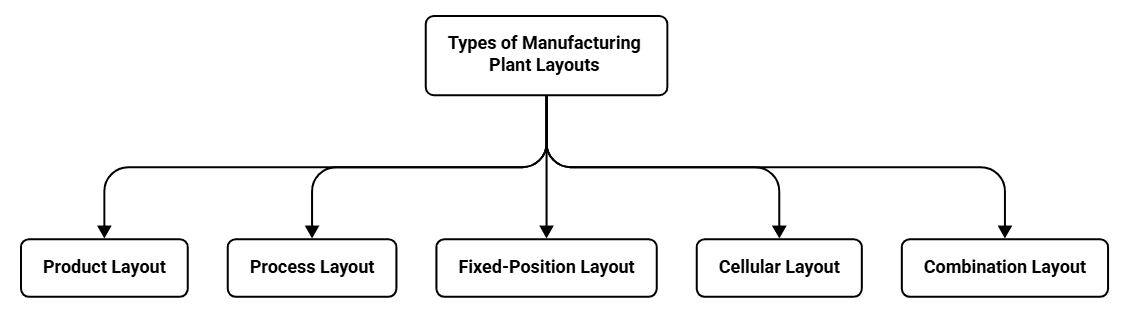
Types of Manufacturing Plant Layouts
The selection of a suitable layout depends on the product, production volume, manufacturing process, and operational requirements.
1. Product Layout
In a product layout, machines and workstations are arranged according to the sequence of manufacturing operations. It is suitable for high-volume production environments, such as automotive assembly and electronics manufacturing.
Key advantage: Supports continuous production and reduces unnecessary material movement.
2. Process Layout
A process layout groups similar machines and equipment according to their functions. It is commonly used in facilities that manufacture different products or handle customized production requirements.
Key advantage: Provides greater flexibility for handling different manufacturing processes.
3. Fixed-Position Layout
In this layout, the product remains stationary while workers, machinery, and materials are brought to its location. It is suitable for manufacturing large or heavy products such as aircraft, ships, and industrial equipment.
Key advantage: Avoids moving large products between different production areas.
4. Cellular Layout
Machines are organized into groups or cells based on similar product families and manufacturing processes. This arrangement supports efficient production of related components.
Key advantage: Reduces material handling and improves production coordination.
5. Combination Layout
A combination or hybrid layout integrates different layout approaches to meet specific manufacturing requirements. It is useful for facilities handling multiple product lines and production processes.
Key advantage: Balances production efficiency with operational flexibility.
Factors Affecting Manufacturing Plant Layout Design
Several technical and operational factors influence the development of an effective Factory Layout Design.
1. Nature of the Product
Product dimensions, weight, specifications, and manufacturing complexity influence equipment positioning and material handling requirements.
2. Production Volume
High-volume production may require assembly-line arrangements, whereas customized or low-volume manufacturing may benefit from flexible layouts.
3. Machinery and Equipment
Machine dimensions, installation requirements, maintenance clearances, and operating conditions must be evaluated before finalizing equipment positions.
4. Material Handling Requirements
The selection of conveyors, forklifts, automated guided vehicles (AGVs), and autonomous mobile robots (AMRs) affects internal transportation routes and space planning.
5. Available Space and Infrastructure
Building dimensions, floor capacity, structural limitations, electrical systems, ventilation, and utility connections must be considered during facility planning.
6. Workforce Requirements
Employee movement, workstation ergonomics, accessibility, and safety requirements influence the overall arrangement of production areas.
7. Future Expansion
Manufacturers should consider potential increases in production capacity, new product lines, and technology upgrades while developing the initial layout.
Benefits of an Efficient Manufacturing Facility Design
A well-executed Manufacturing Facility Design provides several long-term advantages:
- Higher Productivity: Improves coordination between production stages and reduces unnecessary delays.
- Lower Operational Costs: Minimizes material handling, resource wastage, and inefficient space utilization.
- Improved Quality: Supports better process control and smoother movement between inspection and production areas.
- Better Workplace Safety: Provides organized working areas and accessible movement routes.
- Efficient Equipment Utilization: Helps improve machine accessibility, coordination, and maintenance planning.
- Scalable Operations: Makes it easier to accommodate changing manufacturing requirements and future expansion.
Conclusion
Effective Plant Layout Design is essential for developing productive, safe, and cost-efficient manufacturing facilities. By considering material flow, equipment positioning, space utilization, workplace safety, and operational flexibility, manufacturers can create an organized production environment.
A structured approach to industrial plant design also helps businesses integrate modern technologies, improve resource utilization, and prepare their facilities for future manufacturing requirements.
For organizations planning a new facility or optimizing existing operations, working with experienced engineering professionals can help develop a Manufacturing Plant Layout that supports operational efficiency and long-term business objectives.
Frequently Asked Questions (FAQs) About Plant Layout Design
1. What is Plant Layout Design in manufacturing?
Plant Layout Design is the systematic arrangement of machinery, equipment, workstations, storage areas, and other facilities within a manufacturing unit. Its main purpose is to improve workflow, minimize material movement, optimize space utilization, and increase production efficiency.
2. What are the main objectives of plant layout?
The main objectives of plant layout include:
- Maximizing the utilization of available space.
- Reducing material handling and transportation costs.
- Improving production workflow.
- Minimizing production delays and bottlenecks.
- Ensuring workplace safety.
- Supporting future production expansion.
3. What are the different types of plant layouts?
The five common types of plant layouts are:
- Product Layout: Equipment is arranged according to production sequence.
- Process Layout: Similar machines are grouped together.
- Fixed-Position Layout: The product remains stationary while resources move to it.
- Cellular Layout: Machines are organized into manufacturing cells.
- Combination Layout: Multiple layout types are integrated to meet production requirements.
4. What factors should be considered when designing a manufacturing plant layout?
Important factors include production volume, product specifications, machinery requirements, available floor space, material handling systems, workforce movement, utility infrastructure, workplace safety, and future expansion requirements.
5. How does an efficient factory layout improve productivity?
An efficient Factory Layout Design reduces unnecessary material movement, minimizes production bottlenecks, improves equipment accessibility, and streamlines workflow. This helps manufacturers reduce production time, improve resource utilization, and increase overall operational efficiency.
6. What is the difference between product layout and process layout?
Product layout arranges machines according to the sequence of manufacturing operations and is suitable for high-volume production. Process layout groups similar machines together and is suitable for low-volume production with greater product variety.