

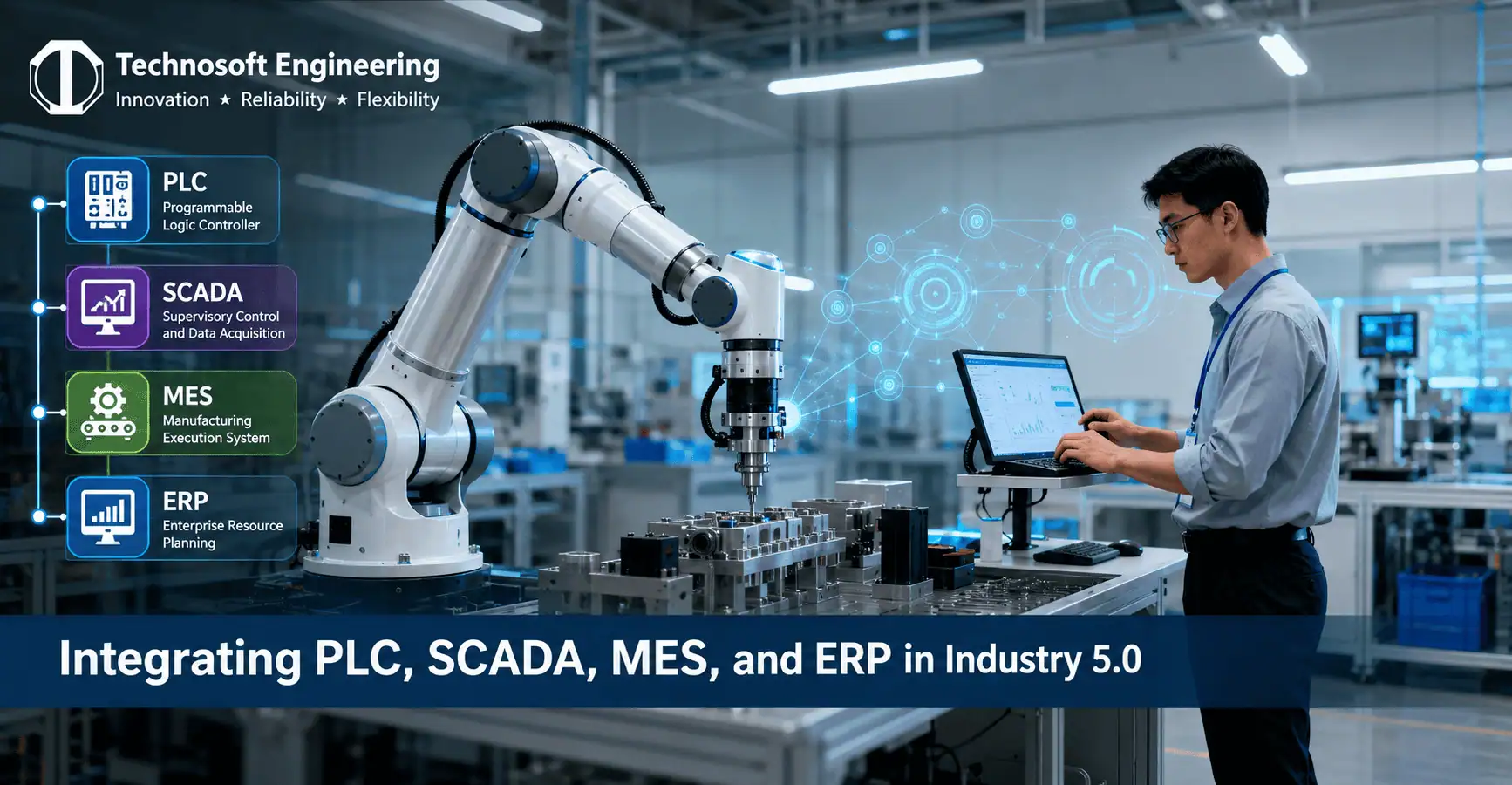
Manufacturing is no longer about machines simply running faster. Today, manufacturers need to know what is happening on the shop floor, why it is happening, and how those events affect production, quality, maintenance, inventory, and business performance.
This is where Industry 5.0 is changing the approach to industrial manufacturing.
Industry 5.0 focuses on creating manufacturing environments where people and advanced technologies work together. But to achieve this, manufacturers need more than individual automation systems. They need connected systems that can share information across the entire organization.
This makes the integration of PLC, SCADA, MES, and ERP increasingly important.
When these technologies are properly connected, data can move from machines and sensors to production teams and business leaders, creating a more responsive, transparent, and intelligent manufacturing environment.
Why Connected Manufacturing Matters
Consider a typical production line.
A PLC knows that a machine has stopped. SCADA can display the alarm. MES may know which production order is currently running. ERP knows the customer order, inventory level, and delivery requirement.
The problem occurs when these systems do not communicate.
An operator may see a machine alarm without knowing its impact on the production schedule. A production manager may discover downtime only after reviewing a report. The purchasing team may not immediately know that a production delay will affect material requirements or delivery commitments.
Integration connects these pieces of information.
Instead of isolated systems, manufacturers can create a connected flow:
Machine → PLC → SCADA → MES → ERP → Business Decision
This approach allows operational information to become useful business intelligence.
Understanding the Four Core Systems
1. PLC Integration: Connecting Machines to the Digital Factory
Programmable Logic Controllers, or PLCs, are at the heart of many automated production systems.
They control machines and processes by receiving information from sensors and sending commands to industrial equipment.
A PLC may control:
- Motors and drives
- Conveyors
- Pumps and valves
- Robotic systems
- Packaging equipment
- Assembly machines
- Process equipment
PLC Integration enables machine-level information to move into higher-level systems.
For example, production counts, machine status, cycle times, alarms, temperatures, and other operating parameters can be made available to SCADA or other manufacturing platforms.
This provides the foundation for collecting reliable shop-floor data without necessarily replacing existing automation equipment.
2. SCADA Integration: Turning Machine Data Into Operational Visibility
SCADA, or Supervisory Control and Data Acquisition, provides operators with a centralized view of industrial processes.
SCADA systems can display machine conditions, alarms, trends, process variables, and equipment status.
However, SCADA becomes significantly more valuable when it is connected to MES and other manufacturing applications.
With effective SCADA Integration, an alarm does not have to remain simply an alarm.
For example:
A machine temperature rises above its normal operating range → SCADA identifies the condition → MES identifies the affected production order → maintenance receives the relevant information → management can understand the potential production impact.
This moves the organization from simply monitoring equipment toward understanding the operational context behind machine events.
3. MES Integration: Connecting Production With the Shop Floor
Manufacturing Execution Systems, or MES, sit between shop-floor automation and enterprise-level planning.
MES platforms can manage activities such as:
- Production orders
- Work-in-progress tracking
- Quality checks
- Product genealogy
- Production reporting
- Operator activities
- Material consumption
- Equipment performance
MES Integration allows production information from PLC and SCADA systems to be connected with manufacturing processes.
For example, MES can associate machine data with a particular product, production order, batch, shift, or work center.
This creates greater traceability and helps production teams understand not only what happened, but also which product or order was affected.
4. ERP Integration: Connecting Manufacturing With Business Operations
ERP systems manage the broader business environment, including inventory, procurement, finance, supply chain, sales, and production planning.
ERP Integration connects manufacturing execution with these business processes.
A typical information flow might look like:
ERP → MES: Production orders, schedules, material requirements
MES → ERP: Production completion, material consumption, quality information
This connection helps reduce manual data entry and creates better visibility between production and business teams.
Instead of production information being manually transferred between systems, relevant data can move automatically according to predefined processes.
How PLC, SCADA, MES, and ERP Work Together
The real value comes from connecting the systems rather than treating each technology as a separate investment.
A simplified architecture can be viewed as four functional levels:
|
Layer |
Technology |
Primary Role |
|
Machine Level |
PLC |
Control and machine data |
|
Supervisory Level |
SCADA |
Monitoring and visualization |
|
Manufacturing Level |
MES |
Production execution and traceability |
|
Enterprise Level |
ERP |
Planning and business management |
This layered approach is consistent with modern manufacturing architectures where information moves between operational technology and enterprise systems.
The architecture can be extended further with IIoT sensors, edge computing, AI, analytics, and cloud platforms.
This is particularly useful for Industry 5.0 because connected data provides the foundation for more intelligent and human-centric decision-making.
What Happens When These Systems Are Not Integrated?
Many manufacturers have invested in automation over several years. As a result, it is common to find equipment and software from different vendors operating within the same facility.
Typical problems include:
Manual Data Collection
Operators may still record machine information manually or transfer production data between systems using spreadsheets.
Limited Production Visibility
Managers may receive production reports hours after an event has occurred rather than seeing the situation in real time.
Difficult Root-Cause Analysis
When PLC, SCADA, MES, and ERP data are stored separately, engineers may have to investigate multiple systems to understand what caused a production problem.
Poor Traceability
Without connected production information, linking a specific quality issue to a machine, batch, material, or production order can become difficult.
Slower Decision-Making
Disconnected information means different teams may work with different versions of the same operational reality.
Integration addresses these gaps by creating a more consistent flow of information across the manufacturing environment.
Technologies That Enable Industrial Integration
Integration does not always require replacing existing systems.
Modern integration architectures can use industrial communication protocols, gateways, APIs, middleware, and edge technologies to connect existing equipment with newer platforms.
Common technologies include:
OPC UA
OPC UA is widely used for secure communication between industrial devices and software applications. It can support data exchange between PLC, SCADA, MES, and other systems.
Modbus TCP
Modbus remains common in industrial environments, particularly when integrating legacy equipment. Gateways can help connect older systems to modern architectures.
MQTT
MQTT is a lightweight publish-subscribe protocol often used for IIoT and sensor data. It can be useful when large numbers of connected devices need to transmit data efficiently.
REST APIs
APIs can connect manufacturing applications with enterprise platforms, including MES and ERP systems.
The right technology depends on the existing infrastructure, equipment vendors, data requirements, cybersecurity architecture, and integration objectives. The goal should be to create reliable communication rather than simply adding more connectivity.
Benefits of PLC, SCADA, MES, and ERP Integration
A well-planned integration strategy can deliver benefits across both operations and business functions.
Real-Time Production Visibility: Teams can gain a clearer view of machine status, production progress, quality information, and operational events.
Improved OEE Monitoring: Connected production data can help organizations monitor availability, performance, and quality more effectively.
Faster Troubleshooting: When machine events are linked with production and operational information, engineers can investigate problems with greater context.
Better Traceability: Production records can be connected to products, batches, materials, equipment, and work orders.
Reduced Manual Work: Automated data exchange can reduce repetitive data entry, spreadsheet-based reporting, and manual reconciliation.
Better Planning: ERP and MES connectivity can help production teams align shop-floor execution with business requirements.
Foundation for Predictive Maintenance: Once reliable machine data is available, organizations can apply analytics and AI to identify abnormal patterns and potential equipment issues.
How Integration Supports Industry 5.0
The biggest benefit of integration is not simply automation. It is the ability to create a manufacturing environment where people can make better decisions using connected information.
For example, an operator may receive an alert about abnormal machine behavior. Instead of responding to a generic alarm, the operator can access information about the affected production order, machine history, quality status, and previous events.
Engineers can use historical data to identify recurring problems.
Production managers can understand how equipment downtime affects schedules. Business teams can see how production performance affects inventory and customer commitments.
This creates a stronger connection between people, machines, and business processes, which aligns closely with the human-centric philosophy of Industry 5.0.
Challenges to Consider Before Integration
Integration can deliver significant value, but it should be approached carefully.
Legacy Equipment
Older PLCs and machines may not support modern communication standards. Protocol converters or gateways can sometimes provide a practical way to connect these assets without replacing them.
Data Standardization
Different systems may use different names, formats, and units for similar information. Establishing a consistent data model is therefore important.
Cybersecurity
Connecting OT and IT environments increases the importance of network segmentation, authentication, authorization, secure communication, monitoring, and access control.
System Compatibility
Different vendors may use different platforms and interfaces. Integration planning should consider existing SCADA, MES, PLC, ERP, historians, databases, and communication protocols.
Scalability
An integration solution should be designed with future expansion in mind. Adding another machine, production line, or facility should not require rebuilding the entire architecture.
Conclusion
The transition toward Industry 5.0 requires manufacturers to think beyond individual automation technologies.
PLC, SCADA, MES, and ERP each perform an important function, but their true value increases when they operate as part of a connected manufacturing ecosystem.
PLC Integration connects machines with the digital environment. SCADA Integration provides operational visibility. MES Integration connects production execution with shop-floor data. ERP Integration links manufacturing activities with broader business operations.
Together, these technologies create a foundation for smarter Industrial Automation, better traceability, faster decision-making, and more responsive manufacturing.
For manufacturers preparing for Industry 5.0, the goal should not be to connect every system simply because connectivity is possible. The focus should be on connecting the right systems, the right data, and the right people to create measurable operational and business value.
Frequently Asked Questions
1. What is PLC Integration in manufacturing?
PLC Integration connects programmable logic controllers with SCADA, MES, historians, analytics platforms, and other systems so machine-level information can be used across manufacturing operations.
2. Why is SCADA Integration important?
SCADA Integration allows real-time machine and process information to be connected with higher-level manufacturing systems, providing better operational visibility and context.
3. What does MES Integration provide?
MES Integration connects production execution with shop-floor and business information, improving production tracking, quality management, traceability, and work-order visibility.
4. What is ERP Integration in manufacturing?
ERP Integration connects manufacturing processes with enterprise functions such as inventory, procurement, production planning, supply chain, and finance.
5. How does this integration support Industry 5.0?
Connected systems give employees better access to real-time and contextual information. This supports the Industry 5.0 focus on human-centric manufacturing, resilience, sustainability, and intelligent use of technology.