


Engineering projects generate a large amount of technical information, from CAD models and design drawings to simulation results, product specifications, and bills of materials (BOMs). As products become more complex and teams work across multiple locations, managing this information efficiently becomes increasingly important.
Imagine a manufacturing team preparing to produce a component using an outdated engineering drawing. Even if the design change is minor, it could result in incorrect parts, additional inspections, production delays, or expensive rework.
Problems like these highlight the importance of Engineering Data Management. By organizing engineering information, controlling revisions, and establishing reliable workflows, organizations can improve collaboration and maintain consistency throughout product development.
In this guide, we explore what engineering data management is, the most common challenges, practical solutions, and the best practices engineering teams can use to improve data accuracy and operational efficiency.
What Is Engineering Data Management?
Engineering Data Management (EDM) is the process of collecting, organizing, storing, controlling, and sharing engineering information throughout a product’s development and operational lifecycle.
It covers both the technical information itself and the documents or files used to communicate that information.
Common examples include:
- CAD drawings, 3D models, and engineering designs
- Product specifications and material information
- Simulation, testing, and validation results
- Bills of materials and component records
- Engineering change requests and approvals
- Manufacturing instructions and quality documentation
The goal is to ensure that authorized team members can find and use accurate, approved information when they need it.
For example, when an engineer modifies a product component, the updated design may affect manufacturing instructions, procurement requirements, and quality inspection procedures. An effective EDM process helps track these relationships and ensures that relevant teams receive the correct information.
Why Is Engineering Data Management Important?
Engineering decisions depend on reliable information. If data is incomplete, duplicated, or outdated, teams may struggle to coordinate their work and maintain product quality.
A structured data management process helps organizations address these problems in several ways.
1. Improve Design Accuracy
Revision control and approval workflows help engineers identify the latest approved drawings and specifications. This reduces the risk of using outdated information during manufacturing.
2. Strengthen Cross-Functional Collaboration
Design, manufacturing, quality, and procurement teams can work from consistent engineering information rather than relying on separate files and email attachments.
3. Reduce Avoidable Rework
When design changes are recorded and communicated properly, teams can identify downstream impacts earlier and reduce preventable errors.
4. Improve Traceability
Maintaining revision histories, approval records, and supporting documentation makes it easier to understand why a change was made and who authorized it.
5. Support Better Project Decisions
Accurate engineering data helps project managers and technical leaders evaluate design progress, identify dependencies, and coordinate resources more effectively.
The benefits depend on how well the processes are implemented, but the underlying objective remains the same: make engineering information more reliable and useful.
What Are the Main Data Management Challenges in Engineering?
As engineering projects grow, information can become difficult to manage across departments, software platforms, and product development stages. Understanding these Data Management Challenges helps organizations identify where improvements are needed.
1. Scattered Engineering Files and Data Silos
Engineering information is often distributed across local computers, shared drives, email attachments, and separate software applications. Different departments may maintain their own copies of the same files.
Example: A design engineer updates a component model, but the manufacturing team continues using an older drawing saved in a shared folder.
Solution: Establish an authoritative repository for engineering information, supported by consistent naming conventions, searchable metadata, and clear access permissions.
2. Version Control and Engineering Change Issues
Product designs change throughout development. Without a controlled revision process, teams may struggle to identify which design is current, approved, or suitable for production.
Solution: Implement revision tracking and formal change approval workflows. Clearly distinguish between draft, under-review, and released documents.
3. Poor Data Quality and Inconsistent Documentation
Missing information, duplicate records, inconsistent part numbers, and incomplete specifications can create confusion and increase the time required to verify engineering details.
Solution: Standardize document templates, required metadata, part numbering, and data validation rules. Conduct regular checks to identify and correct inconsistencies.
4. Limited Integration Between Engineering Systems
Engineering teams may use CAD, simulation, PDM, PLM, ERP, and manufacturing systems. When these tools do not exchange information effectively, employees may need to enter the same information repeatedly.
Solution: Assess integration requirements and establish clear rules for data ownership, synchronization, and validation between connected systems.
5. Data Security and Intellectual Property Risks
Engineering documents can contain proprietary designs, product specifications, and confidential technical information. Poorly managed permissions or uncontrolled file sharing can expose these assets.
Solution: Use role-based access, secure authentication, appropriate encryption, audit trails, and tested backup and recovery procedures.
Engineering Data Management Solutions for Modern Businesses
The right Data Management solution depends on the organization’s engineering processes, existing technology, product complexity, and long-term objectives.
Rather than selecting software based only on features, businesses should identify their biggest data-related problems and choose capabilities that address them.
1. Centralized Engineering Data Management
A centralized repository provides a controlled location for engineering drawings, CAD files, specifications, and related documentation.
Useful capabilities include:
- Searchable file and document records
- Consistent naming and metadata
- Controlled access and permissions
- Revision history and document status
- Links between related engineering records
A shared repository can improve visibility, but organizations with complex CAD dependencies or formal release processes may need a dedicated PDM or PLM platform.
2. Product Data Management (PDM)
Product Data Management systems focus on controlling product-related engineering files, CAD models, revisions, and document workflows.
They can help teams manage design changes, prevent conflicting edits, and identify approved versions of technical files.
PDM is particularly useful when multiple engineers collaborate on assemblies or components that depend on one another.
3. Product Lifecycle Management (PLM)
Product Lifecycle Management platforms support broader product-related processes, connecting engineering information with activities such as change management, manufacturing planning, and product support.
Depending on the platform, PLM can help manage product structures, BOMs, approvals, and lifecycle records across multiple departments.
For organizations developing complex products, PLM can provide a more connected view of product information than document management alone.
4. Workflow Automation
Manual approval processes can slow engineering projects and create gaps in communication.
Workflow automation can route design changes to reviewers, notify stakeholders when documents are released, and maintain records of decisions. These workflows should include appropriate validation and human approval for safety-critical or technically significant changes.
5. Engineering System Integration
Connecting engineering software with relevant business systems can reduce repeated data entry and improve consistency.
For example, approved product information may need to flow from an engineering system into ERP or manufacturing systems. Integration should preserve revision status, data relationships, and approval requirements rather than simply copying files between platforms.
6. Cloud-Based Data Management
Cloud-based solutions can help distributed teams access shared engineering information without relying exclusively on local infrastructure.
However, organizations should assess security requirements, data residency, software compatibility, performance, backup arrangements, and supplier access before choosing a cloud or hybrid approach.
Data Management Best Practices for Engineering
Implementing technology is only one part of the process. Sustainable results require clear standards, defined responsibilities, and regular reviews.
The following Data Management Best Practices can help engineering teams build a more reliable foundation.
1. Standardize File Naming and Metadata
Define consistent conventions for project identifiers, part numbers, document types, revision codes, and file names.
For example, a controlled document record might include a project ID, component number, revision, approval status, and owner. The exact structure should match the organization’s existing engineering standards.
2. Establish a Single Source of Truth
Identify the authoritative location for approved engineering information. Teams should know where to find released drawings, specifications, and BOMs instead of relying on local copies.
Read-only access to released documents can help prevent accidental changes.
3. Implement Formal Revision Control
Record important design changes, revision history, approval status, and release dates.
Define who can create, review, approve, and release engineering documents. Make sure downstream teams understand how approved changes affect their work.
4. Define Data Ownership and Governance
Assign responsibility for maintaining engineering information. Design engineers, document controllers, quality teams, and system administrators may have different responsibilities.
Clear ownership helps resolve inconsistencies and ensures that important records do not become neglected.
5. Automate Repetitive Tasks
Automate suitable processes such as document routing, approval notifications, revision alerts, and routine data validation.
Keep exceptions visible and retain human oversight where engineering judgment or formal approval is required.
6. Protect Data and Maintain Backups
Apply access permissions based on job responsibilities. Review access regularly and maintain backup and recovery procedures that are tested, documented, and appropriate for business continuity requirements.
7. Audit Data Quality Regularly
Review engineering records for duplicate files, missing metadata, obsolete documents, and inconsistent part numbers.
Correct issues at their source wherever possible so that the same errors do not appear repeatedly across different systems.
8. Measure Performance Using Relevant KPIs
Track indicators that reflect the actual problems the organization wants to solve, such as:
- Time required to find approved engineering documents
- Average engineering change approval time
- Number of revision-related errors
- Duplicate or incomplete engineering records
- Time spent correcting data inconsistencies
Establish a baseline before implementing changes, then review the results over time. This helps teams assess whether their processes and technology are delivering meaningful improvements.
Engineering Data Management vs. PDM vs. PLM
|
Approach |
Primary focus |
Typical application |
|
Engineering Data Management (EDM) |
Managing engineering information, documents & data processes |
Maintaining controlled, accessible engineering records |
|
Product Data Management (PDM) |
Managing CAD files, product data, revisions, and engineering workflows |
Coordinating design files and component revisions |
|
Product Lifecycle Management (PLM) |
Managing broader product-related processes and information across the lifecycle |
Connecting design, change management, manufacturing, and product support |
The exact capabilities vary by implementation. PDM is often used as a focused engineering data management capability, while PLM can provide a broader framework for product lifecycle processes.
Businesses should select an approach based on their workflows and integration needs rather than assuming that every organization requires a full PLM implementation.
How to Choose the Right Data Management Solution
Selecting an appropriate solution starts with understanding how engineering information currently moves through the organization.
Consider the following factors before making a decision:
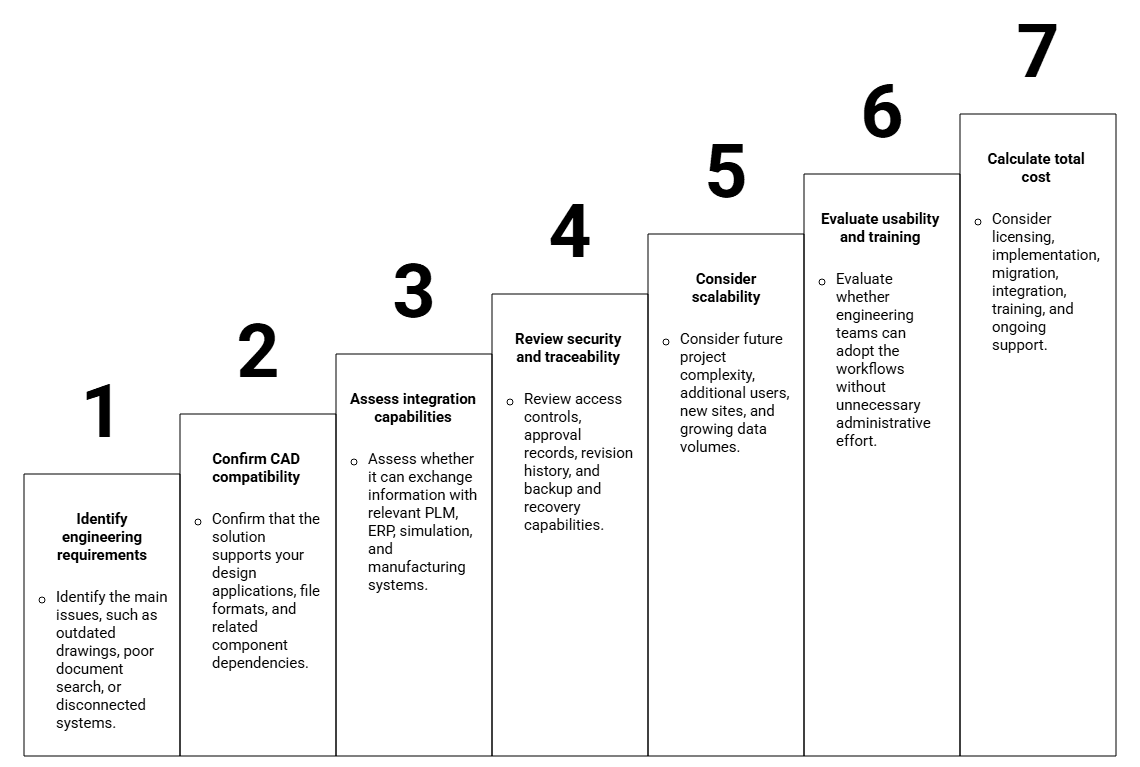
A phased rollout is often a sensible approach. Start with a high-priority workflow, define success criteria, validate the results, and then expand to other teams or projects.
The Future of Engineering Data Management
Digital engineering, connected manufacturing, simulation, and AI-assisted design are increasing the importance of accurate and well-structured engineering information.
AI-enabled tools may help classify documents, improve search, identify inconsistencies, or assist with information retrieval. Their effectiveness depends on data quality, access controls, system integration, and appropriate validation.
As engineering systems become more connected, organizations will need to maintain reliable data relationships, control design changes, and preserve traceability across workflows.
The priority is not to adopt every new technology. It is to establish trustworthy engineering data and processes that allow new tools to deliver practical value.
Conclusion
Engineering Data Management helps organizations maintain accurate, accessible, and controlled engineering information throughout product development and manufacturing.
By addressing common Data Management Challenges, implementing the right solutions, and following effective Data Management Best Practices, businesses can improve collaboration, reduce errors, and streamline engineering workflows.
Looking to improve your engineering workflows? Start by reviewing how your teams manage CAD files, design revisions, technical documents, and engineering changes. Identifying gaps in these processes can help you determine which data management improvements will deliver the greatest value